Showing posts with label elgar. Show all posts

05 July 2021

"A lovely camisole for 11/6d" : the 1927 HMV mobile recordings at Hereford

The HMV van at Hereford Cathedral, September 1927


Following the adoption of electrical recording in 1925, someone at the Gramophone Company (HMV) saw an opportunity for making records outside a dedicated studio or nearby building connected by GPO landline.

This led to the construction of the "Mobile Van" in 1926. A purpose-built Lancia commercial vehicle, registration number ML1003 (Middlesbrough County Borough), which contained seven tons of recording equipment. Housed at Gramophone Company headquarters in Hayes, Middlesex, it could be driven to locations across the United Kingdom. Although planned to make conventional recordings, it opened up the possibility of making recordings of performances in "real-time", as they happened.

The van's first task was to record Harry Goss-Custard playing the brand-new organ of Liverpool Anglican Cathedral on 8th February 1927

Famous recordings made on the van in 1927 included Ernest Lough singing in London's Temple Church in Mendelssohn's Hear my prayer, and cellist Beatrice Harrison duetting with a nightingale in her Oxted garden at "Foyle Riding".
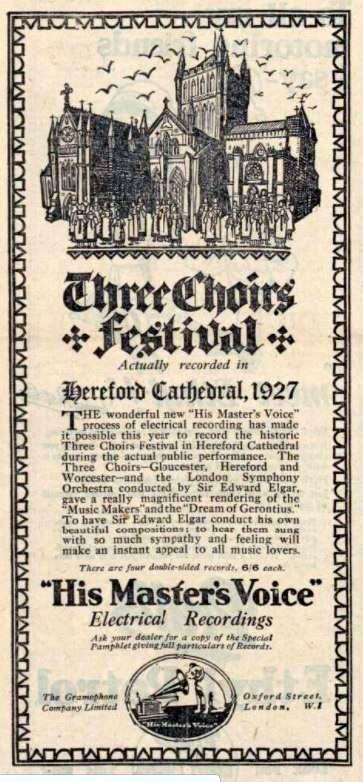

HMV advertisement
Sheffield Daily Telegraph, Friday 20 January 1928

Early in the year the Gramophone Company started negotiations with the Three Choirs Festival Committee to make live recordings that the Hereford Festival in September 1927. One of their star artists, Sir Edward Elgar, was due to conduct not only The Dream of Gerontius and The Music Makers but also the premiere of his Civic Fanfare, specially commissioned for the opening concert in the cathedral.

The Bedfordshire Times and Independent reviewed the records on Friday 3rd February 1928. The review gives us a good idea of the impact the records made on contemporary listeners remembering, also, that they would have been heard on an acoustic gramophone, incapable of reproducing the finer details:

The Dream was performed at the last Three Choirs Festival in Hereford Cathedral under the conductorship of Sir Edward Elgar himself, and records were made of one or two passages by means of the mobile recording apparatus.

The results are vividly realistic - and most tantalizing! Directly the first record begins we are actually in the cathedral, no effort of imagination needed : the sensitive microphone has caught and transmitted to the recording apparatus not merely the beauty of tone and detail of the performance, but the actual sense of the presence of large assembly. One is so conscious of forming part of that hushed audience that the abrupt break at the end of the record is quite a shock. However, we are but eavesdroppers and must be thankful that modem science can do so much for us.

The eavesdropping begins with the passages "So, pray for me" and "O Jesu help" in Part I. The solo part is sung with extreme poignancy by Tudor Davies, and the choral and orchestral background beautifully proportioned and distinct in every detail (the orchestra is the London Symphony Orchestra). In Part II we hear Horace Stevens singing with solemn impressiveness "Jesu, by that shuddering dread", and Margaret Balfour's exquisitely tender rendering of "Softly and gently", after the last few bars of the tenor’s final passage, "Take me away". The close of this record is the most tantalizing moment: if only we could hear the rest—that glorious blinding of earthly prayers and celestial hymns of praise. 

This is not all, however. There are two records containing passages from Elgar’s The Music Makers, the composer again conducting, and Brewer's Nunc Dimittis, and in each the choral singing is extremely fine. Referring generally to all four records it is difficult to praise too highly the skill of the "HMV" experts in securing such well-proportioned and beautiful reproductions.

The reviewer in the Yorkshire Evening Post of Saturday 28th January 1928 was cautious about the results:

Recording Public Performances. 

Three Choirs' Festival on Gramophone. 

The most ambitious attempt yet made to record for the gramophone an actual public performance of great musical works was that of the H.M.V. Company at the Three Choirs Festival a few months ago in Hereford Cathedral. The discs were made by the aid of microphones fixed in the cathedral and connected with a mobile recording laboratory mounted on a motor lorry which stood at one the entrances. They have now been issued and gramophone enthusiasts will able to judge the progress which has been made. 

The portions of the festival recorded are three numbers from Sir Edward Elgar's The Music Makers and four from The Dream of Gerontius, all conducted by the composer. It is appropriate that Elgar should be associated in this way with such a development, for he and his father were violinist and organist together in the orchestra of earlier Three Choirs Festivals which go back well over 200 years, while Sir Edward has shown keen personal interest the development of gramophone. 

Difficulties. 

Frankly, one must regard these records as largely experimental. The difficulties which have to be overcome are great; but it must be said at once that the reverberations of the cathedral and the noises made the congregation, such as the movement of chairs and coughing, are much less intrusive than one has heard in broadcast performances under similar conditions. 

The fact that the performance cannot be regulated to suit the recording is apparent in two or three instances where the music on the disc finishes abruptly; but in the circumstances this is almost unavoidable. In the louder choral passages, the cathedral adds a characteristic echo, and it will found in playing these records that a much better effect is obtained listening to them at some distance from the gramophone—from adjoining room through open door, for example. There is doubtless some scientific explanation for this. 

The tenor soloist in The Dream  is Tudor Davies, who has developed rather irritating mannerisms on the operatic stage; but in the cathedral his singing sounds much finer than one had expected. 

The music of these records often attains real beauty, and to lovers of Elgar's choral works they will be especially welcome, while the H.M.V. technicians will have gained valuable experience for future efforts.

The Daily Herald's reviewer, on Tuesday 24th January 1928, took a more light-hearted approach:

CHOIRS FESTIVAL RECORDS

Church Atmosphere on the Gramophone

When the singer won't go to the gramophone recording studio, the studio must go to the singers. So a neat lorry drove up to Hereford Cathedral last September and waited there during the Three Choirs Festival

The lorry was connected to a microphone inside the cathedral, and the result of this quiet visit is the production of four H.M.V. records of the actual singing of Elgar's Music Makers and The Dream of Gerontius. The atmosphere of a great church is uncannily conveyed, and there is a general effect of strength and singularity.

Forty-five years later, in a letter to the editor of The Gramophone of 2nd October 1972, retired HMV engineer Bernard Wratten recalled those Hereford recordings:

One evening, after the day's music making was done, Dr. Hull invited us round to his house, where we found an impressive assortment of English composers, singers and musicians. While we were there he told us that the wife of a local baronet, a lady with a considerable reputation for silliness, had been so taken with the hat of another member of the audience sitting just across the aisle during a rehearsal that she leant over to ask, under cover of combined choir and orchestra, where the hat had been bought. She had to raise her voice and at that moment the music stopped, She was clearly heard all over the Cathedral.

The tale acquired its widely circulated form from our Public Relations Officer. It had nothing whatsoever to do with our recording but he felt there was a good news-story in it, and after decorating it he sent it out to the newspapers, most of which published it.

It was Gramophone Company veteran, friend of Elgar, and Artistic Director of the International Artistes' Department, Fred Gaisberg who recorded the most decorated version of this story in his 1942 autobiography The Music Goes Round. He also provided a valuable insight into the successes and failures of mobile recording:

One of the first innovations to follow electric recording was a mobile van, with which we could realize the dream of recording actual performances. We used it with all the gusto of a new toy. The Royal Choral Society choir of 800 strong was recorded during a Messiah performance in the Albert Hall, Gerontius at Worcester Cathedral during a Three Choirs Festival, and massed bands of 1,000 players at the Crystal Palace. The Covent Garden Opera, Staatsoper in Berlin, La Scala in Milan, and the Paris Opera were all recorded later during actual performances. Many of these records were issued to the public and had a great success. For instance, the sale of the “Hallelujah Chorus” and “Lift Up Your Heads” afforded the Royal Choral Society a revenue for several years that made up the loss on many a concert.

Yet often apologies had to be tendered for coughs, sneezes and snorts from the conductor. In Toscanini’s case, for instance, he always sings along with the ’cello part and grinds his teeth. In the actual performances of opera the prompter, spitting out the cues and singing the entrance notes for the singers, disturbed the enjoyment of these records. 

Once at the Three Choirs performance of Gerontius, during a sudden silent pause after a forte climax, a lady’s voice talking about “a lovely camisole for 11/6d” was clearly exposed when the record was played back, and so ruined a fine set. ["11/6d" would have been spoken as "eleven-and-six" or "eleven shillings and sixpence." In decimal currency it is the equivalent of 57.5p, or £23.44 in 2017.]

Before any of this “on the spot” recording could be projected commercially, complicated negotiations had to be undertaken with each individual unit concerned—choir, orchestra, soloists, conductor, Dean of the Cathedral and even the sexton, and their signed permission obtained before recording could legally be undertaken. At first the public bought these records because of their novelty, but afterwards the sales dropped off and the heavy costs made the venture unattractive for the gramophone companies. 

... 

At the first Music Festival at Queen’s Hall, a fine recording conducted by Toscanini, of the Brahms Second Symphony, was ruined by so much coughing, an unmistakable sign of an influenza epidemic, that the records had to be destroyed.  

C1329
The Temple Church Choir, thanks to the masterly training of Sir Walford Davies, came into great prominence, but it was their gramophone recording of Hear My Prayer, one of the early commissions of the mobile van, that brought it international fame and caused the dusty old “church of the lawyers” to be so overwhelmed by visitors from the Dominions and the U.S.A. that tickets of admission had to be issued. The recording took place in 1926 at a special private session in the Temple Church. Thalben Ball was the choirmaster and organist, and Ernest Lough, then between 14 and 15, was the solo boy. A happy combination of chance helped to make this lovely record: the soft, acoustic resonance of the church, a boys’ choir with a fine discipline, a choirmaster who was a first-rate trainer, and a gifted boy with a musical sensibility and a silver voice just then at its prime. A year later the moment would have passed, for the voice had changed.  

The fame of record C1329 spread like wildfire and in a few years close on one million copies were sold. The royalties payable to the Temple Church really embarrassed the lawyers, so unexpected was their sum total. After bonuses to each member of the choir there was sufficient left over for a fine holiday. With the balance they founded a scholarship. 

Although Bernard Wratten in his 1972 letter said that HMV's Public Relations Department used this myth to promote the 1927 Hereford recordings, there is no evidence of this before the Nottingham Journal's item of Friday 13th November 1931. This was on the occasion of the inauguration of the new recording studios in Abbey Road, St John's Wood, by Sir Edward Elgar. The van had been built its own garage at Abbey Road:

GRAMOPHONE FLYING SQUAD. 

REMARK THAT WAS “PUT ON RECORD.”

(From Our Own Correspondent.) London, Thursday. 

Adjoining the vast new recording studios of the H.M.V. Company at St. Johns Wood, inaugurated to-day by the London Symphony Orchestra under Sir Edward Elgar, is a garage which accommodates the "flying squad" of the gramophone world.

In it is a large enclosed van containing all the apparatus necessary for making a record in readiness to set out for any part of the country in short notice. 

It has been all over the North and Midlands to choir festivals, organ recitals and public gatherings.

It was used to make a record of an organ recital by Dr. Bairstow, at York Minster, and it has been to Leeds and Hereford for their famous choral festivals. 

"The apparatus carried weighs seven tons," one of the operators told me to-day, "and so the car has to driven very carefully. We can move when occasion requires, however. 

"The funniest experience I ever had when recording from the van was at Hereford. We were in the middle of making a record of the Three Choirs Festival when suddenly, to our horror, a remark from somebody near the microphone came through loud and clear on our speaker. It was a pointed reference to the silk stockings worn by one of the ladies present. We decided to scrap that record."


The Hereford photo of the van published in 1927 in a mock-up of the van outside York Minster 


07 November 2020

Elgar, Binyon, Martin-Harvey and 'Arthur'

Title-page of Elgar's full score.
Courtesy of the British Library.


 To

SIR JOHN and LADY MARTIN HARVEY

With what names should I inscribe this play but with yours? Yet what right have I to dedicate to you what is already so much your own? Memory goes back to the June day, now long ago, when first I undertook to write for you a play out of Malory's pages on a theme long pondered by you both. And many days come back to me, in London or by the sunny Channel, when time was forgotten in ardent work and interchange of ideas; in rejecting and recasting; in the search for essential structure. How much the play owes to you, both in framework and in detail, none knows so well as I. Give me leave, therefore, to write these words in grateful acknowledgement of that initial trust, of much fruitful suggestion and inspiriting counsel, and of all I have learnt from you of the playwright's patient craft.


With these words, the playwright Laurence Binyon introduced his play Arthur: a tragedy. The dedication is to my ancestor, Sir John Martin-Harvey and his wife who acted as 'Miss N. da Silva', and the music for the first production was written by Sir Edward Elgar.

In February 1998, Anthony Payne's elaboration of the sketches which Elgar made for his Third Symphony received its first public performance in London's Royal Festival Hall.

For the first time, people who had not been familiar with the sketches either as they were published in The Listener or W.H. Reed's Elgar as I Knew Him (1936) became aware that the symphony seemingly drew on Elgar's music for Binyon's play Arthur.

I want to present here some paragraphs taken from The Autobiography of Sir John Martin-Harvey (Sampson Low, Marston and Co, 1933), which explain the background to Binyon's play in some detail. Then I want to discuss briefly Elgar's music for the play, and how it relates to the Third Symphony sketches.


Martin-Harvey's account of the genesis of the play

After the production of Oedipus Rex at Covent Garden in 1912-13, a new ambition had taken possession of me. In my mind arose again the loved stories of my youth - those of Malory's Morte d'Arthur. What would be more glorious than to produce a play on the great British theme of Arthur, written by a British poet, in settings by a British artist, in the foremost British Theatre?

Laurence Binyon for the poet, my old friend Professor Robert Anning Bell for the designer, and Covent Garden Opera House for the production!

Binyon had entered enthusiastically into the project and many an hour had we spent with my wife over the construction of the play in her cottage at Bonchurch, to which he refers so charmingly in his dedication of the printed copy.

Our original idea was that Lancelot [Binyon used the spelling 'Launcelot', but Martin-Harvey does not follow this] should be the leading character; but, when I read the play aloud, my wife much preferred my expression of the King, and, with Binyon's concurrence, it was decided that I should play Arthur. This necessitated some changes in the latter part of the play which Binyon willingly made. In the meantime, consultations with Anning Bell over the costumes had been frequent and a large staff of workpeople had been carrying them out at Covent Garden Opera house.

Then came a disappointment. I had approached Robert Loraine to play 'Lancelot' and he had agreed, though at that time he was not in fit condition to undertake any work. He was war-weary and his doctor insisted upon a long sea voyage to re-build his health. The production of the play was postponed and, as I now had the tenancy of Covent Garden on my hands, I decided to revive Hamlet there for four weeks, with the same production which had been received with such favour at the Shakespeare Tercentenary performances at His Majesty's Theatre in 1916.

The postponement of Arthur was a great disappointment to us all, and conditions have changed so greatly since the War that I have not yet found it possible to produce the play. The fact is that the traditions in which I had been brought up were, before the War, still a powerful influence in my imaginative conception of poetical drama and were moulded on the old Lyceum lines - long casts, vast scenes, great crowds, elaborate and subtle lighting effects, large orchestras and all the rest of it. These things are no longer possible. The glories of that long line of Irving productions, in these days of Trade Union tyranny and mass discipline, can never return.

Perhaps the drama will be none the worse; for these are not essentials - "the Play's the thing" - and the acting. It is partly characteristic of the changed point of view in the matters that, whereas I had spent sixteen hundred pounds on costumes for Arthur, the 'old Vic', where the play was ultimately produced, has staged it complete for fifteen pounds, ten shillings!

Yes; an opportunity had presented itself for its production there, and after Binyon's disappointment I could not say 'No' to the opportunity; besides, I very much wanted to see the play brought to life. It is only then that one can finally judge of its form. Alas! the play was staged at a time when I was travelling and I could not see it, but I had a later chance.

The dramatic section of the London County Council Literary Institute in Drury Lane prayed for permission to give the play, and it was performed there by girls on an occasion when my wife and I were in Town, and very well too. The representation renewed my admiration for Binyon's noble work and confirmed my intention to produce the play whenever the favourable moment can be seized. There is so insignificant a public for such plays in London that it would be courting bankruptcy to stage it there, but that it will be welcomed and supported by an audience in the country I am convinced.

In the midst of these hectic movements I received news of our King's gracious bestowal of the dignity of Knighthood upon me, an honour which he himself had chosen as one which would be equally shared with my wife, in recognition of her long and arduous services during the War.


Elgar's music for the play

Sir Edward Elgar and Laurence Binyon first collaborated in the three-part choral work The Spirit of England. Binyon quickly became a friend and in 1923 asked the composer to write incidental music for the production of Arthur.

In a letter to Binyon the composer wrote in January 1923:
I want to do it but since my dear wife's death [in 1920] I have done nothing & fear my music has vanished ... my wife loved your things & it may be that I can furnish (quite inadequately) music for Arthur.  Can you give me three days more to “try’?
Elgar's score amounted to nearly 90 pages ranging from a few bars to one piece of nearly five minutes. He scored the work for flute (doubling piccolo), clarinet, 2 cornets, trombone, drums, percussion, harp, strings and piano. Elgar drew much of his music from his old sketchbooks. 

The scenes of the play, and Elgar's contributions, are:

Scene 1: Sir Bernard's castle at Astolat

  • Introduction to Scene 1
  • Now you have told me
  • End of Scene 1
End of Scene 1.
Courtesy of the British Library.


Scene 2: A room in the Palace in London: the King and Sir Bedivere

  • Introduction to Scene 2
Introduction to Scene 2.
Courtesy of the British Library.


Scene 3: Sir Bernard's castle at Astolat: Elaine asleep

  • Introduction to Scene 3
  • Put me on the barge
  • Link to Scene 4

Scene 4: The Banqueting Hall at Westminster

  • Introduction to Scene 4
  • Curtain rises
  • And both dangerous
  • It may be
  • The Queen
  • King Arthur’s Fellowship
  • As the King wills
  • The radiant rose
  • Our Queen!
  • Ah false
  • Reading letter

Scene 5: The Queen's Tower at night

  • Introduction to Scene 5
  • No tree was there

Scene 6: The King's Tower, the same night


Scene 7: The King's camp before Joyous Gard and Battle Scene

  • Introduction to Scene 7
  • Go, Lucan, to meet her
  • Thy sword, my life, are yours
  • End of Scene 7

Scene 8: Arthur's passage to Avalon

  • Introduction to Scene 8


In a letter to Binyon after the performances Elgar wrote:
...for theatrical purposes I sh. have like Arthur & all his train to march mistily past, seen through a window on the stage R.
A sentiment with which Martin-Harvey might well have sympathised.

Elgar's Third Symphony

What was the significance to Elgar of the themes which he first used in Arthur and then re-used in his Third Symphony?
  • Elgar's second movement is a scherzo and uses for its main opening section the central section of the introduction to Scene 4 (The Banqueting Hall at Westminster).
  • For the second subject of the final movement of the symphony, Elgar used the theme which appears (in the Hurst recording) at 1' 20" in the introduction to Scene Two (The King and Bedivere). The theme is based on an arpeggio figure and is strongly reminiscent (to me) of the "chivalric" themes of Elgar's old Froissart overture.


11 September 2020

Elgar, Binyon and 'Arthur'

To
SIR JOHN and LADY MARTIN HARVEY

With what names should I inscribe this play but with yours? Yet what right have I to dedicate to you what is already so much your own? Memory goes back to the June day, now long ago, when first I undertook to write for you a play out of Malory's pages on a theme long pondered by you both. And many days come back to me, in London or by the sunny Channel, when time was forgotten in ardent work and interchange of ideas; in rejecting and recasting; in the search for essential structure. How much the play owes to you, both in framework and in detail, none knows so well as I. Give me leave, therefore, to write these words in grateful acknowledgement of that initial trust, of much fruitful suggestion and inspiriting counsel, and of all I have learnt from you of the playwright's patient craft.

With these words, the playwright Laurence Binyon introduced his play Arthur: a tragedy. The dedication is to my ancestor, Sir John Martin-Harvey and his wife, and the music for the first production was written by Sir Edward Elgar.

In February 1998, Anthony Payne's elaboration of the sketches which Elgar made for his Third Symphony received its first public performance in London's Royal Festival Hall.

For the first time, people who had not been familiar with the sketches either as they were published in The Listener or W.H. Reed's Elgar as I Knew Him (1936) became aware that the symphony seemingly drew on Elgar's music for Binyon's play Arthur.

I want to present here some paragraphs taken from The Autobiography of Sir John Martin-Harvey (Sampson Low, Marston and Co, 1933), which explain the background to Binyon's play in some detail. Then I want to discuss briefly Elgar's music for the play, and how it relates to the Third Symphony sketches.

Martin-Harvey's account of the genesis of the play

After the production of Oedipus Rex at Covent Garden in 1912-13, a new ambition had taken possession of me. In my mind arose again the loved stories of my youth - those of Malory's Morte d'Arthur. What would be more glorious than to produce a play on the great British theme of Arthur, written by a British poet, in settings by a British artist, in the foremost British Theatre?

Laurence Binyon for the poet, my old friend Professor Robert Anning Bell for the designer, and Covent Garden Opera House for the production!

Binyon had entered enthusiastically into the project and many an hour had we spent with my wife over the construction of the play in her cottage at Bonchurch, to which he refers so charmingly in his dedication of the printed copy.

Our original idea was that Lancelot should be the leading character; but , when I read the play aloud, my wife much preferred my expression of the King, and, with Binyon's concurrence, it was decided that I should play Arthur. This necessitated some changes in the latter part of the play which Binyon willingly made. In the meantime, consultations with Anning Bell over the costumes had been frequent and a large staff of work-people had been carrying them out at Covent Garden Opera house.

Then came a disappointment. I had approached Robert Loraine to play 'Lancelot' and he had agreed, though at that time he was not in fit condition to undertake any work. He was war-weary and his doctor insisted upon a long sea voyage to re-build his health. The production of the play was postponed and, as I now had the tenancy of Covent Garden on my hands, I decided to revive Hamlet there for four weeks, with the same production which had been received with such favour at the Shakespeare Tercentenary performances at His Majesty's Theatre in 1916.

The postponement of Arthur was a great disappointment to us all, and conditions have changed so greatly since the War that I have not yet found it possible to produce the play. The fact is that the traditions in which I had been brought up were, before the War, still a powerful influence in my imaginative conception of poetical drama and were moulded on the old Lyceum lines - long casts, vast scenes, great crowds, elaborate and subtle lighting effects, large orchestras and all the rest of it. These things are no longer possible. The glories of that long line of Irving productions, in these days of Trade Union tyranny and mass discipline, can never return.

Perhaps the drama will be none the worse; for these are not essentials - "the Play's the thing" - and the acting. It is partly characteristic of the changed point of view in the matters that, whereas I had spent sixteen hundred pounds on costumes for Arthur, the 'old Vic', where the play was ultimately produced, has staged it complete for fifteen pounds, ten shillings!

Yes; an opportunity had presented itself for its production there, and after Binyon's disappointment I could not say 'No' to the opportunity; besides, I very much wanted to see the play brought to life. It is only then that one can finally judge of its form. Alas! the play was staged at a time when I was travelling and I could not see it, but I had a later chance.

The dramatic section of the London County Council Literary Institute in Drury Lane prayed for permission to give the play, and it was performed there by girls on an occasion when my wife and I were in Town, and very well too. The representation renewed my admiration for Binyon's noble work and confirmed my intention to produce the play whenever the favourable moment can be seized. There is so insignificant a public for such plays in London that it would be courting bankruptcy to stage it there, but that it will be welcomed and supported by an audience in the country I am convinced.

In the midst of these hectic movements I received news of our King's gracious bestowal of the dignity of Knighthood upon me, an honour which he himself had chosen as one which would be equally shared with my wife, in recognition of her long and arduous services during the War.


Elgar's music for the play

Sir Edward Elgar and Laurence Binyon first collaborated in the three-part choral work The Spirit of England. Binyon quickly became a friend of Elgar and in 1923 asked the composer to write incidental music for the production of  Arthur.

In a letter to Binyon the composer wrote in January 1923:

I want to do it but since my dear wife's death [in 1920] I have done nothing & fear my music has vanished ... my wife loved your things & it may be that I can furnish (quite inadequately) music for Arthur.

Elgar's score amounted to nearly ninety pages ranging from a few bars to one piece of nearly five minutes. He scored the work for flute (doubling piccolo), clarinet, two cornets, trombone, drums, percussion, harp, strings and piano. He wrote introductions to eight of the nine scenes of the play (omitting No 6). In the original production the music began before the end of the third scene and continued into the fourth. Elgar drew much of his music from his old sketchbooks.

The scenes of the play are:

Scene 1: Sir Bernard's castle at Astolat

Scene 2: A room in the Palace in London: the King and Sir Bedivere

Scene 3: Sir Bernard's castle at Astolat: Elaine asleep

Scene 4: The Banqueting Hall at Westminster

Scene 5: The Queen's Tower at night

Scene 6: The King's Tower, the same night

Scene 7: The King's camp before Joyous Gard and Battle Scene

Scene 8: Arthur's passage to Avalon

In a letter to Binyon after the performances Elgar wrote:

...for theatrical purposes I sh. have like Arthur & all his train to march mistily past, seen through a window on the stage R.

A sentiment with which Martin-Harvey might well have sympathised.


Elgar's Third Symphony

What was the significance to Elgar of the old themes which he first used in Arthur and then reused in his Third Symphony?

These are the themes:

  • Elgar's second movement is a scherzo and uses for its main opening section the central section of the introduction to Scene 4 (The Banqueting Hall at Westminster).
  • For the second subject of the final movement of the symphony, Elgar used the theme which appears (in the Hurst recording) at 1' 20" in the introduction to Scene Two (The King and Bedivere). The theme is based on an arpeggio figure and is strongly reminiscent (to me) of the "chivalric" themes of Elgar's old Froissart overture.